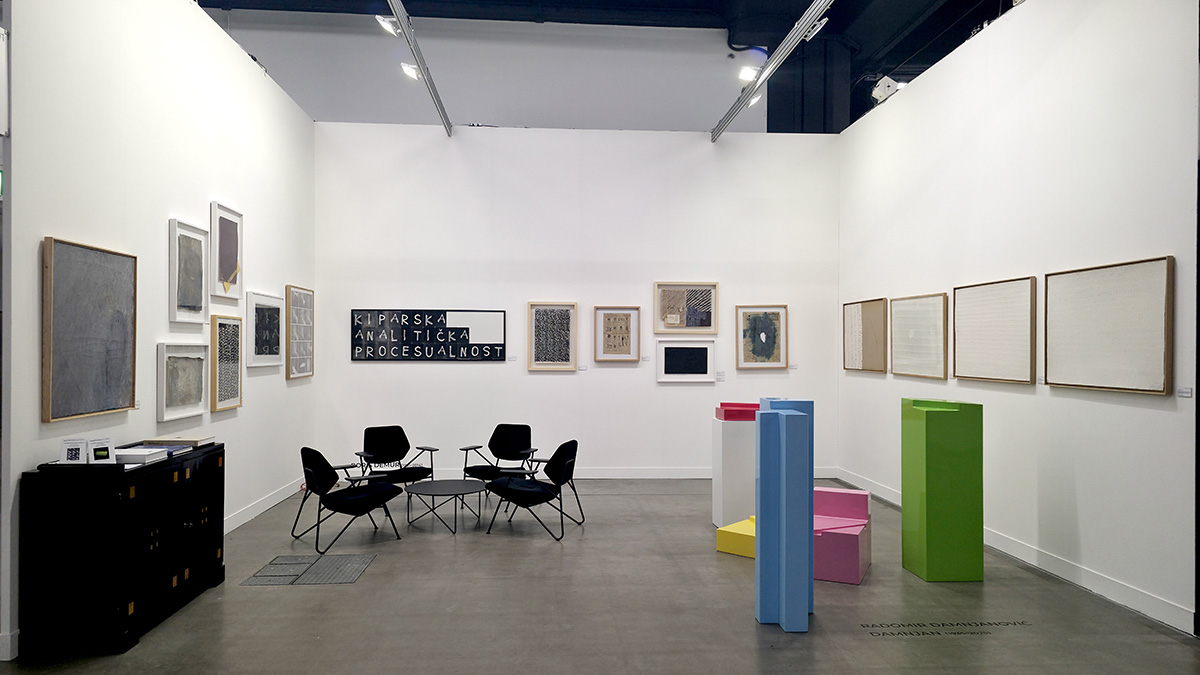
For miart 2026, Avantgarde Gallery (Zagreb, Croatia) presents a curatorial project bringing together three artists: Radomir Damnjanović Damnjan, Boris Demur, and Zoran Todorović. The presentation traces a line from the analytical and conceptual procedures of the 1970s to later critical artistic practices, emphasising the continuity of formal discipline and critical
reflection across generations.
In keeping with the fair’s theme, New Directions, the project considers the ways in which artists expand the language of art through precise investigations of medium, perception, and the relationship between idea and form.
Radomir Damnjanović Damnjan (1935, Mostar – 2025, Milan) was one of the key artists of the Yugoslav and Italian avant-garde. In the cycle Paintings (2019–2020), Damnjan appropriates the medium of sculpture and uses it to produce works that he explicitly defines as paintings. Each work consists of a metal structure treated with industrial pigment, yet its status does not primarily derive from the object’s physical characteristics, but rather from its title and conceptual intention, which unequivocally establish it as a painting executed in the medium of sculpture. This does not merely introduce a terminological shift, but rather enacts a precise conceptual reconfiguration of medium as a means of artistic expression.
Such a turn does not imply the simultaneous existence of a sculptural and a painterly work, but rather the production of a new form of artistic expression that eludes conventional categorisation. In this sense, the Paintings cycle continues Damnjan’s long-standing investigation of appropriation, naming, and the dematerialisation of the artwork, in which the work acquires its full determination only within the conceptual framework that defines its identity. The selection from the Paintings cycle highlights precisely this perceptual and conceptual shift, presenting works that exist above all through the concept that defines them, rather than through the expected formal properties of the medium.
Boris Demur (1951–2014, Zagreb) was one of the key figures of the Croatian New Art Practice. Formed within the Zagreb conceptual circle and a co-founder of the Group of Six Authors, he developed an exceptionally consistent artistic language in which painting, text, photography, and process-based thinking are continuously re-examined. Works such as 20 Minutes of Rubbing with Paint, 40 Strokes, and I Repeat, as well as the photographic and processual bodies of work from the late 1970s, demonstrate the breadth of his analytical approach. In works such as Elementary Sculpture, Sculptural Process, Analytical Sculpture, and Sculptural Analytical Processuality, photography assumes the physical, material, processual, and problem-based properties of sculpture – photography becomes sculpture. Here we present a selection of works that confirms Demur’s oeuvre as one of the most consistent analytical bodies of work in European contemporary art.
Zoran Todorović (b. 1965, Belgrade) explores systems of social control, surveillance, and participation, using the body both as medium and as subject. His work Assimilation (1997–2010) is one of the most demanding and radical achievements of European conceptual art. Presented through photographic and video documentation, the work records an action in which the artist prepared and offered meals made from human biological tissue collected as waste from aesthetic surgery clinics. By transforming this material into an object of consumption, Todorović confronts the audience with the ethical and political dimensions of assimilation as both a biological and cultural process.
The work problematises notions of purity, exchange, and the limits of the human body in contemporary society. It continues Todorović’s consistent strategy of exposing the mechanisms of biopolitical control seen in his other works. Assimilation is presented as a key document of performative research into the material and symbolic economy of the body, and as a work that raises questions about the mechanisms shaping contemporary human identity and ethics.
The joint presentation of Damnjan, Demur, and Todorović establishes a dialogue spanning several decades of artistic production. Each of these artists redefines the relationship between medium
and meaning in a distinct way. Together, they trace a continuous movement from the analytical examination of artistic language toward more complex forms of conceptual and critical articulation, in keeping with the theme of New Directions, which affirms the reinvention of the familiar through structure, rhythm, and conceptual improvisation.