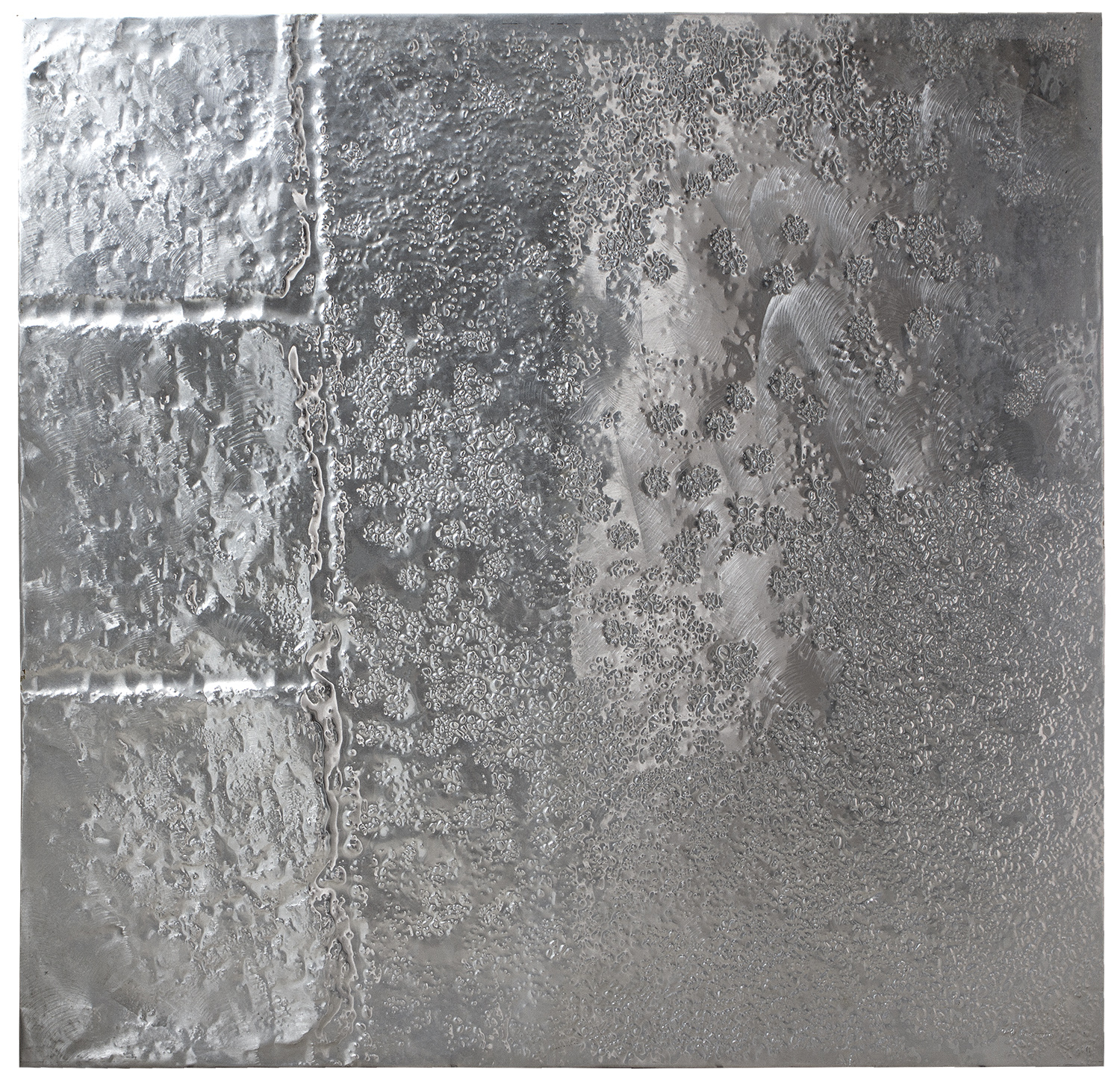
Baldo Diodato is an Italian artist whose decades-long body of work is marked by an analytical approach to urban space, collective memory, and phenomena of presence. His practice stems from an interest in the relationship between the artistic process and the urban context, whereby art does not reproduce reality but analytically deconstructs it. Within this framework, the technique of imprinting (primarily frottage and bas-relief) becomes the central working method. Frottage, a process of rubbing the surface of paper or canvas placed on a substrate, and bas-relief, a shallow relief in which form emerges directly from the surface, allow for the direct recording of the material, historical, and social layers of space.
Diodato’s early work developed within the collective Operativo Sud 64, founded by art historian Achille Bonito Oliva. Even then, Diodato moved away from traditional expressive forms and focused on investigating the conditions of artistic production – material, surface, context. After relocating to New York in 1966, where he remained for 26 years, his work took on a strong performative and conceptual orientation. Public space became his medium, and the city (its texture, rhythm, and use) became the subject of systematic analysis.
A notable example of this approach was carried out in 1974 on John F. Kennedy Plaza in Philadelphia. The artist placed a large-format canvas (6 × 6 m) on the ground, exposing it to direct interaction with passersby. The imprints of their steps, pauses, and movements did not form an image but instead created a collective frottage, a non-subjective, uncomposed record of the physical presence of the community. In this context, Diodato’s work functions as “physical evidence” of the interaction between body and space, a form of documentary archive of everyday life.
Upon returning to Italy in 1992, Diodato continued using the same method of investigation in the context of cities such as Rome, Naples, Casacalenda, and others. Particularly significant is a series of imprints of Roman sanpietrini (stone paving blocks) that form the microstructure of the historical urban landscape. Using aluminium or copper plates as the medium for transferring surfaces, the artist creates precise relief records of micro-locations, and in some cases, includes the public (passersby, observers) in the process of creating the works.
Diodato’s practice is deeply rooted in the principles of analytical art, as theoretically formulated by the post-conceptual generation from Joseph Kosuth to the members of Art & Language. Within this framework, the artwork does not communicate information about reality but addresses the conditions of its existence – material, linguistic, and procedural. In Diodato’s work, trace, surface, aluminium, and public space form a closed system of meaning in which the work simultaneously functions as document, action, and epistemological model.
His methods can be described as meta-linguistic, where the work does not serve as a representation of memory, but as a form of reflection on the very conditions of recording and presence. Frottage and imprinting are for him defining procedures through which art analyses itself. In this way, his practice aligns with tautological models of conceptual art in which the act of recording becomes the work’s content and structure. The work does not depict memory – it defines it through material, temporal, and social contact.